
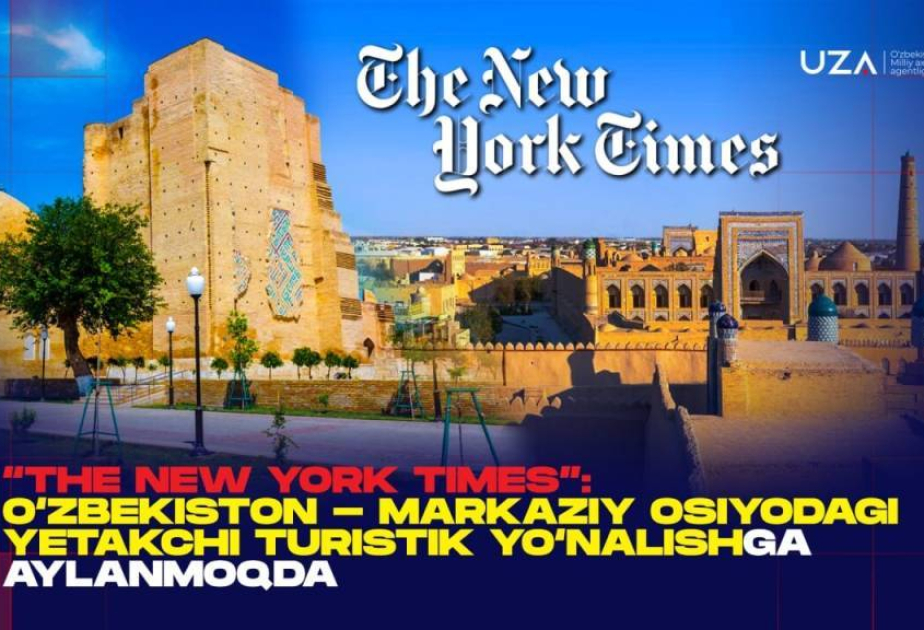
The famous American newspaper, The New York Times, has featured an article about Uzbekistan’s rising appeal among global travelers. The article was written after a nine-day journey across the country by journalist and photographer Gabe Castro-Root, according to Uza.uz
Uzbekistan is gaining traction with young travelers seeking beauty, authenticity, and low prices. Its rich cultural heritage, affordability, safety, and sense of spontaneity and adventure are making the country increasingly attractive to millennial and Gen Z travelers.
“But no Central Asian nation has gotten more attention, or better positioned itself to capitalize on it, than Uzbekistan”, the author writes.
Since 2016, Uzbekistan has steadily opened up to foreign visitors. The government has sponsored influencers and travel bloggers, while major cultural initiatives, including the inaugural Bukhara Biennial, have drawn international attention to the country’s art and culture. President Shavkat Mirziyoyev has also ordered the construction of hundreds of new hotels, and Uzbekistan has stopped requiring visas for U.S. citizens visiting for up to 30 days.
Those efforts are paying off. Uzbekistan welcomed a record 11.7 million international visitors in 2025, compared with 6.7 million in 2019. Fewer than 37,000 visitors came from the United States in 2025, but that figure was more than double the 17,000 Americans who visited in 2019.
A significant part of the article is devoted to Uzbekistan’s historical and cultural landmarks. In Tashkent, the author highlights the Alisher Navoi Theater, the Tashkent Metro, and Chorsu Bazaar. Samarkand is presented through the Registan, the Shah-i-Zinda necropolis, and the Gumbaz Synagogue, reflecting the city’s rich architectural, spiritual, and multicultural heritage.
In Bukhara, the article focuses on Labi Hovuz and the centuries-old tradition of carpet weaving. Khiva is portrayed through the Itchan Kala, the city’s walled inner fortress and a UNESCO World Heritage site.
Uzbek hospitality is one of the article’s central themes. The author recounts repeated acts of unexpected kindness from residents, showing how personal encounters and human warmth made the journey through Uzbekistan especially memorable.
The New York Times presents Uzbekistan as a safe, hospitable, and rapidly changing country with a rich cultural heritage and growing appeal to international travelers. The article further strengthens the country’s image as one of Central Asia’s leading tourist destinations.