
Written byRosie McCall
Not even ancient canines are immune to a little Photoshop, with Egyptologists at the Fitzwilliam Museum in Cambridge, U.K., discovering that an illustration of a jackal seems to have been edited to look slimmer.
The correction appears in a 3,000-year-old Book of the Dead belonging to a high official named Ramose, who lived during the New Kingdom in the 13th century B.C.E. and worked as a senior royal scribe. According to the Fitzwilliam Museum, the funerary text contained spells and instructions designed to help Ramose pass safely into the afterlife.
While prepping the manuscript for a new exhibition, Helen Strudwick, curator of the Made in Ancient Egypt exhibition and senior Egyptologist at the Fitzwilliam Museum, discovered some unusual markings. A little digging suggests the white pigment may be the Ancient Egyptian version of modern-day Tipp-Ex or Wite-Out.
Ancient Egyptian Wite-Out
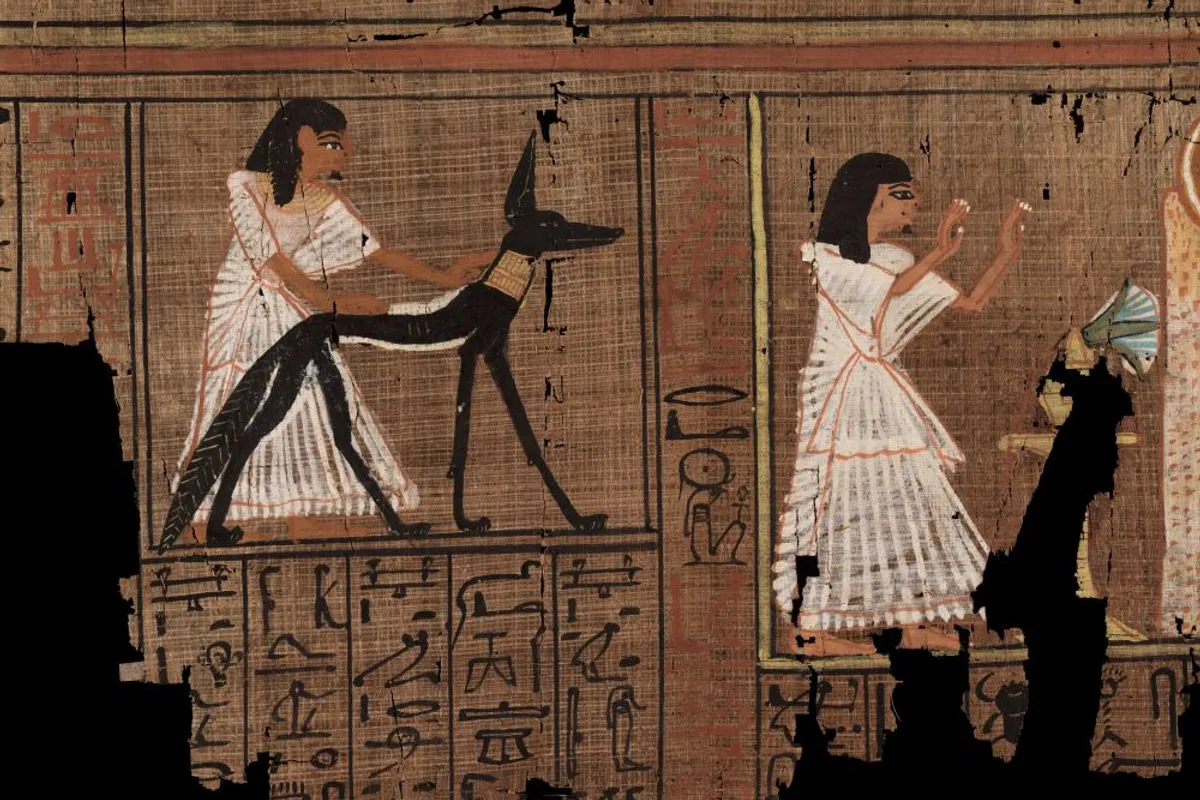
The edit appears on a decorative vignette — or illustration — linked to Spell 117, which depicts Ramose in a long white robe alongside a jackal-headed god believed to be Wepwawet.
The canine, painted black, is shown with two white pigment stripes, one on each side of its body. Recent examinations show the pigment may have been added to make the jackal appear thinner.
“I think the original way it was painted was consistent with a representation of a domestic dog, rather than a jackal, which is a desert scavenger and often rather skinny,” Strudwick told Discover.
Infrared photography enabled the team to peel back the layers of the papyrus to see what lay beneath the pigment. The images show the white paint covering part of the jackal’s body.
“It’s as if someone saw the original way the jackal was painted and said, ‘it’s too fat; make it thinner,’ so the artist has made a kind of ancient Egyptian ‘tippex’ — also known as ‘Wite-out’ or ‘Liquid Paper’ – to fix it,” Strudwick said in a press release.
The team determined the pigment's composition, finding it to be a combination of huntite and calcite. In contrast, the white paint used for Ramose’s robe contains huntite only.
The addition of calcite would have thickened the paste, possibly making it easier to cover the black pigment of the jackal.
The mixture also contains flecks of yellow orpiment, an arsenic mineral used as a pigment in the ancient world. According to Strudwick, this would have allowed the pigment to blend in with the papyrus, which would have been a pale cream color at the time.
Strudwick explains it is not yet possible to say when the edits took place.
“It could be that there was a process of checking by a master scribe or artist before a papyrus like this was passed to the person who had ordered it, or it could be that Ramose himself (who was a senior royal scribe) reviewed it and said it needed to be changed. But this is speculation,” she told Discover.
Stephen Quirke, Professor of Egyptian Archaeology at University College London, U.K., said the use of the white paint as an adjusting device was “highly intriguing.”
“The papyrus of Ramose is a remarkable survival,” Quirke, who was not involved in the discovery, told Discover. “There are many Book of the Dead papyri from the New Kingdom period, but relatively few survive from burials of high-ranking officials, and few have been found outside the cemeteries of the main kingship cities, Thebes and Memphis.”
Quirke explained that the papyrus came from a cemetery site near Henennesut (modern Ihnasya), a strategic regional town.
Other Examples of 'Wite-Out' in Ancient Egypt
The Book of the Dead for Ramose may not be the only example of ancient “tippex” being used to correct a mistake. Strudwick has encountered other examples. This includes the Book of the Dead of Nakht, which features white pigment next to the face of the god Osiris and the goddess behind him. In the papyrus of Yuya, a ba-bird (a bird with a human head) is shown with a white stripe along its back.
"When I have pointed them out to curators, they’ve been astonished,” Strudwick said in a press release.