
Jerusalem Post
ByMIRIAM SELA-EITAM
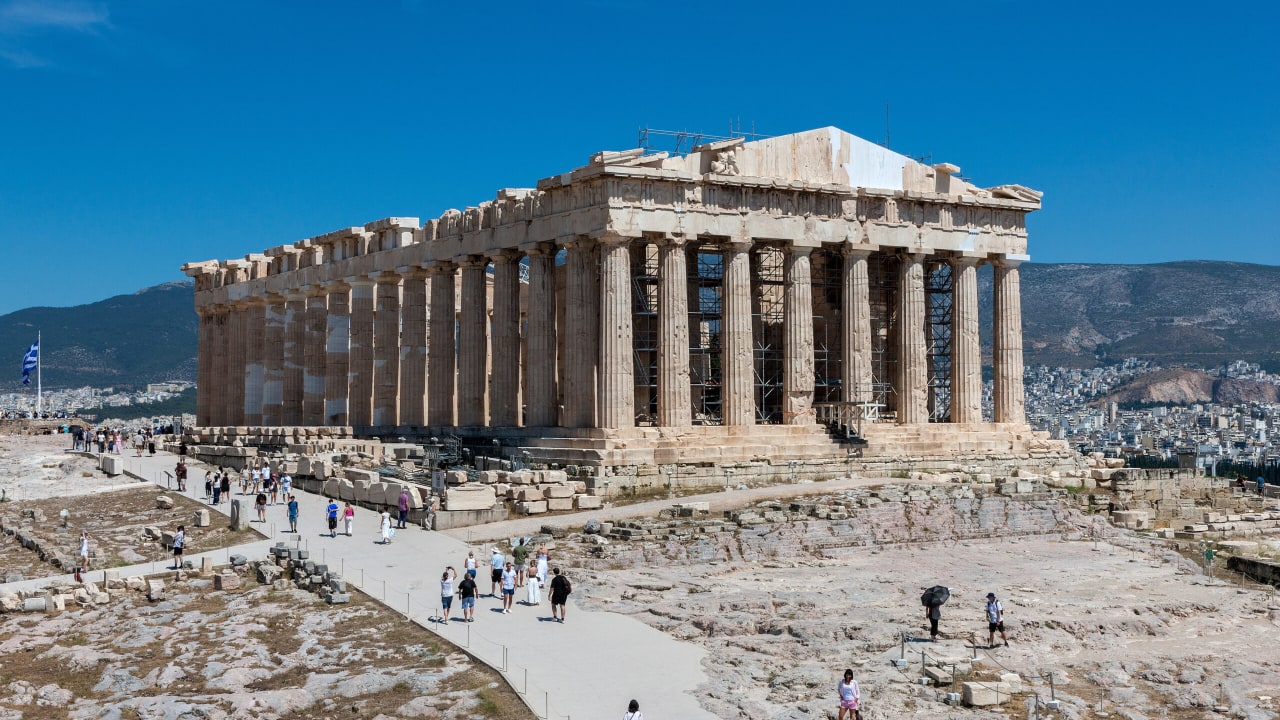
The external scaffolding hiding the Parthenon’s western face was removed in early June following the completion of the monument’s back wall.
Visitors to the Parthenon will finally be able to view the monument’s complete western pediment for the first time in approximately 220 years, since before the founding of the modern Greek state.
The external scaffolding hiding the Parthenon’s western face was taken down in early June following the completion of the monument’s back wall, a little under a year since the temporary removal of the scaffolding in September and October of 2025.
Restoration of the site, spearheaded by the Acropolis Restoration Service (YSMA) and the Committee for the Conservation of the Acropolis Monuments (ESMA), began in 1983 and later intensified throughout the 2000s.
Advertisement
Two orthostats - vertical stone plaque in Mediterranean antique architecture - were placed against the back wall of the monument by YSMA to return the wall to its former stature.
YSMA noted in an early June statement that the the restoration of the tympanum's orthostats served as “one of the greatest challenges of recent years” for the service, adding that the project required “surgical precision” across every stage of the restoration.
The restored western face of the Parthenon, Greece, July 2, 2026. (credit: Acropolis Restoration Service)
Marble blocks, hewn from the Dionyssos Quarry where ancient architects pulled their stones from, were hand-carved by expert craftspeople before being brought to the Acropolis and carefully set within the monument according to plans drawn up by engineers and scientists.
“The sixth (from the north) block of the tympanum was restored to its original geometry by mending two ancient fragments with new marble supplements,” YSMA said, “while the seventh block was made entirely of new marble.”
Destruction of the Parthenon
The Parthenon’s destruction occured over centuries of warfare, the most recently significant incident being during the Morean War between the Ottomans and the Ventians in the 17th century.
Advertisement
Ahead of a Venetian attack, the Ottoman’s fortified the Acropolis and used the Pantheon as a storehouse for their gunpowder supply, despite warnings of the danger such a move posed.
The site was also used as a shelter for the local community.
On September 26, 1687, the Venetians fired a mortar round from the Hill of Philopappos (located southwest of the Acropolis), targeting the Ottoman’s ammunition storehouse. Some 300 people were killed in the explosion, and the monument’s central portion and inner chambers (the cella) were destroyed.
The ancient monument again became the target of military fire during the Greek War of Independence in the early 19th century.
"A few months ago we were speaking about the first unobstructed view of the Parthenon in decades, free from the external scaffolding that had covered its western side,” Greek Culture Minister Lisa Mendoni said in an early June statement “Today, we are speaking about the completion of an exceptionally demanding restoration intervention, thanks to which the western pediment of the Parthenon is being returned to its most complete form in approximately 220 years.”
Mendoni described the sight as “breathtaking,” adding that the Parthenon’s pediment has now “reclaimed its architectural unity. Today, we behold the western pediment of the Parthenon as it has not been seen for two centuries.”
“This is a moment of historic significance for the monument, for the Acropolis, and for world civilization. A moment that fills us with pride, but also with the responsibility to continue, with the same consistency, the great work of protecting and showcasing the foremost symbol of Western Civilization."
Greece calls for return of Parthenon Statues from British Museum
This is the second time in recent months that the Parthenon has become the focus of the public eye.
In late May, a total of 20 countries formally announced their support over the weekend for Greece’s request for the permanent return of the famed Parthenon Sculptures during the 25th session of UNESCO’s Intergovernmental Committee for the Return of Cultural Property to Countries of Origin (ICPRCP).
The Parthenon Sculptures, taken from the Parthenon and other temples from the Acropolis by the British Ambassador to the Ottoman Empire Thomas Bruce, have been an ongoing point of contention between Greece and the UK.
Within the ICPRCP, the subject has been on committee’s agenda since 1984.
The Greek Culture Ministry explained that the Greek delegation to the ICPRCP presented during the meeting a detailed and comprehensive historical account of the Parthenon Sculptures.
Greece’s arguments focused on several matters, including Elgin’s acquisition of the Statues, the “destructive consequences” that the removal had on the Statues’ preservation, and the lack of respect the British Museum has shown the pieces.
According to the Greek delegation, Elgin had no firman (a royal decree issued by a sovereign in an Islamic state) or relevant Ottoman documents permissing him to remove the artifacts from Greece.
In response, the UK reiterated its established position on the matter, claiming that Elgin had received a firman and that the removal of the Statues was entirely lawful, pointing to an 1816 investigation into Elgin’s conduct that had ruled his actions legal.
Turkey, from its position as an observer state, stressed that no document legitimizing the removal of the Sculptures and their acquisition by Elgin existed, and called on the UK to “stop using the existence of such a firman as an argument in international intergovernmental forums.”
The restoration of the Parthenon’s western facade was completed using funds from the Greek Recovery and Resilience Fund by the Acropolis Restoration Service, under the supervision of the Committee for the Conservation of the Acropolis Monuments.

.webp)